A reminder that there will be a Sung Mass this Sunday at 5pm,
at St. Patrick's, College Rd. Kilkenny
Mass will be that of the 17th Sunday after Pentecost (Justus es Domine)


 |
| "Battle of Vienna", by Józef Brandt, 1863. Museum Wojska Polskiego in Warsaw |

 | |||
| Relic of St. Oliver Plunkett |
 |
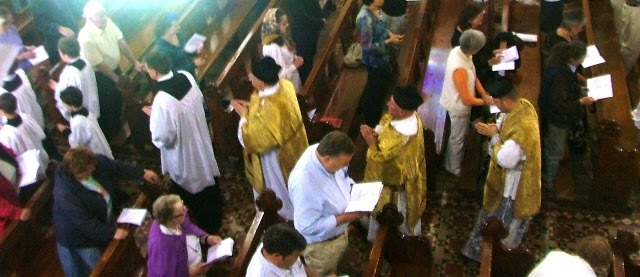
| Pre- Mass practice |
 |
| Servers practice |


 |
| Apse mosaic in the Papal Basilica of Sancta Maria Maggiore Ant. Speciosa * facta es et suavis in deliciis tuis, sancta Dei Genitrix. O Holy Mother of God thou art become beautiful * and gentle in thy gladness. |
"When Liberius was Pope, a Roman patrician named John, and his wife, also of noble birth, having no children to inherit their goods, vowed their inheritance to the most holy Virgin Mother of God. The blessed Virgin heard their prayers and approved their vow by a miracle. On the 5th of August, which is that time when the heat of summer waxeth greatest in the City, a part of the Esquiline Hill was covered by night with snow. And on that same night, the Mother of God told John and his wife separately in dreams that they should build a church on that place. When John told this to Pope Liberius, he said that he had had the same dream. The Pope therefore went to the snow-covered hill and there marked out a site. The church was built with the money given by John and his wife, and was later restored by Sixtus III. It hath been given various names ; but, so that its title may indicate its excellence, it is called the Church of St. Mary Major."Archaeological evidence does indeed show an earlier church on the site with the present Basilica dating back to the fifth century AD. Its construction tied to the Council of Ephesus of 431 AD, which proclaimed Mary "Theotokos, Mother of God."

"We live in an age, when many are no longer able to distinguish the good fruits of a holy life from the evil fruits born of slavery to sin. The confusion and error is so pervasive that it has even entered into the life of the Church and threatened the highest and most perfect expression of her life, the Sacred Liturgy, the public worship of God. "

''...this book was written (and, this is the important distinction) by a Vatican theologian, and published by a Vatican-based publisher. This would have been unthinkable just a few short years ago.''
''Gherardini is a Canon of St. Peter’s Basilica, a secretary for the Pontifical Academy of Theology, a professor emeritus at the Pontifical Lateran University, and the editor of Divinitas, a leading Roman theological journal. The book includes a forward by Bishop Mario Oliveri (ordinary of the Italian dioceses of Albenga and Imperia) and an introduction by Archbishop Malcolm Ranjith, former secretary of the Congregation for Divine Worship and now Archbishop of Colombo."

To quote from the book itself:
"The purpose of Vatican II, in fact, sets it apart from any other Council, especially Trent and Vatican I. Its scope was not to give definitions, nor was it dogmatic or linked to dogma; it was pastoral. Thus based on its specific nature it was a pastoral Council." [55]
...
"In all truth Modernism hid itself under the cloak of Vatican II's hermeneutic...The new rite of Holy Mass practically silenced the nature of sacrifice making of it an occasion for gathering together the people of God...the eucharistic gathering was given the mere sense of sharing a meal together...After having said all of this about Vatican II, if someone were to ask me if, in the final analysis, the modernist corruption had hidden itself within the Council documents themselves, and if the Fathers themselves were more or less infected, I would have to respond both yes and no...But yes as well, because not a few pages of the conciliar documents reek of the writings and ideas of Modernism--this can be seen above all in GS." [92--boldface mine]
...
"This [the general guidance of the Holy Spirit at a Council] does not mean that the Holy Spirit may not encounter formal or material resistance from the free-willed men who give life to the counciliar event. It is from this possibility that there arises the great risk which casts itself upon the background of the Council...namely, the possibility that it may even fail in some way. Someone has even gone further and has asked if an Ecumenical Council can fall into error in Faith and Morals. The opinions are at variance..." [29, boldface mine.]
...
"Anyone who, in quoting it [VII], puts it on a par with Trent or Vatican I, and accredits to it a normative and binding force which it does not possess in itself, commits a crime and, in the final analysis, does not respect the Council itself." [30]
...
"It is absurd...to even think that modern and contemporary culture--that which is understood as having its beginning in the Enlightenment and which today finds expression in 'weak thought,' or materialism, or indifferentism and relativism--can be recognized as a natural development of ancient Tradition." [34]
...
"[A] reconciliation of the Church and the world was being spoken of." [46, boldface in original]
...
"Let me say immediately that not even a single dogmatic definition included in the intentions of LG or the other Vatican II documents. The Council--we do well not to forget this--could not have even proposed one since it had refused to follow along the lines traced out by other Councils...This means that none of its doctrines, unless ascribable to previous conciliar definitions, are infallible or unchangeable, nor are they even binding: he who denies them cannot, for this reason, be called a formal heretic." [58. Boldface mine.]
...
"It is licit, therefore, to recognize a dogmatic nature in Vatican II only where it re-proposes dogmas defined in previous Councils as the truth of Faith." [59]
...
"GS and DH formed the Anti-Syllabus of condemnation...[so that] a relationship of cooperation could be built up, cooperation even with those who were shackled in proclaimed and condemned errors." [82]
....
[After VII] "[A] missionary conception of the Church now freed from any form of or temptation to proselytism...this type of ecumenism, unfortunately, found a license to legitimacy from the spirit of assisi, thanks to the 'multi-religious' meeting celebrated there..." [86-87]
...
"The Council, therefore, in spite of its basic arguments, became imprisoned by the distress of the 'temporary' and the tyranny of the 'relative.' [ 93. Boldface mine.]
...
"[A] reform is not necessarily a development; it could actually be its opposite." [102]
...
[After VII, there was] "...the signing of insane agreements like that on 'justification' which leaves out the articulus stantis et cadentis ecclesiae upon which Luther had founded his reform...frenzied ecumenism [even]...official declarations of the saving efficacy of non-Catholic professions of the Christian faith and even Judaism..." [110]
...
"As a result [of the likes of Rahner], a tombstone was placed over metaphysics...Rahnerians make up a large part of the Bishops who have the Church in their hands...The air we breathe to this day continues to be both defiled and defiling." [118-121. Boldface mine.]
...
"How many times the very men, into whose hands Jesus had entrusted the sacred deposit of the Faith, solemnly and pompously said 'no' to this or that doctrine, like the Marian Coredemption, because otherwise it will prejudice ecumenical dialogue. It was as if to say, 'There is no other truth or value besides ecumenical dialogue.'..." [122.]
...
"It is only to the Church's authentic Magisterium that the Holy Spirit entrusts the office of transmission. It would not be a bad idea if some of the enlightened, post-conciliar innovators (who so flippantly presume to attach the Holy Spirit to their personal theories) were to reread at least a couple of the 26 theses of Franzelin on Tradition..." [135. Bold face mine.]
...
"'I would not even be ready to believe in the Gospel, if the authority of the Catholic Church were not to compel me to do so'...[quoting St. Augustine]...Tradition, in the last analysis, is the very life of the Church; its action upon the Church comes about through an iter or sacramental or institutional guaranteed by the Holy Spirit." [142-143.]
...
"Scripture is not, strictly speaking, the living Word of God; it is the witness and memorial of Gods Word. For this reason Scripture is sacred and venerable; yet it does not have the saving efficacy of the other instruments of salvation (i.e. the Sacraments)." [144-145]
...
"Scripture is divinely inspired, Tradition is divinely assisted; both of them pass on the 'Good News' of the saving mystery..." [152]
...
"...Is there not in SC itself an element of that which Pius XII had so strongly worked to keep at bay?" [168]
...
"And if someone passed through that door to introduce into the Church a Liturgy subversive to the very nature and primary end of the Sacred Liturgy...the responsibility for this, in the final analysis, is none other than the conciliar text itself." [171-172]
...
"[T]he Liturgy which systematically boycotted the versus Domino orientation, the sacredness of the rite, the sense of latria, the irreplaceable beauty of Gregorian chant, the solemnity of gestures and vestments, and kneeling...[was committed in a] boundless cult of man..." [186-187.]
...
"It is to be remembered that no one is morally free before the truth (God, revelation, true religion). Directly willed ignorance that leads a person to reject that which he is duty-bound to know is an act of grave, more irresponsibility; actually, it is the gravest moral mistake...The position of DH, therefore, rests on an absurd paralogism whose false reasoning makes equivocations, appeareances, or illusions seem true then indeed they are not...Worse still is the judgment helf by many theologians and egoumenoi of the Holy Church regarding the Church's missionary nature: a judgment which is theoretically and practically opposed to proselytism...Some have even reached the point...of counseling against conversion to Christianity...this is very different and distant from the tree described in MK 4:32...." [211-215]
...
"The content of DH and the contents of the previous Magisterium are different. So there is neither continuity nor development of the previous Magisterium in DH." [217]
...
"Man himself, for whose salvation God Himself became incarnate and offered Himself as an expiatory sacrifice, was elevated by the Council and placed as the center of ecclesial activity: "Man himself, whole and entire, body and soul, heart and conscience, mind and will' (GS 3). This capsized the thought of St. Thomas Aquinas who taught that God cannot create for ends which are foreign to His own reality." [220]
...
"I have already made mention of this anthropocentrism in the Constitution GS, a concern which Vatican II manifests in general through its dedication to man. It is a concern steeped in naivete and, I would say, in irrational kindness; it is based upon the dignity of the human person and the exaltation of his freedom through predominantly naturalistic premises. As a consequence, devastatingly little is said about the due distinction between the ontological and moral in man. This can be seen in n.22. In this passage there is not only the devastation of naive, ecumenical nature which is absurd and unsustainable, but one of unprecedented gravity precisely because it wishes to unite its own absurd thought to Christ Himself...That this reveals an absurdity (that of confusing the natural with the supernatural, which throws all to the cards on the table regarding the anthropocentric conception of the Council) is clearly understood in the events after the Council; notwithstanding, if there is a more ridiculous absurdity it is the following: 'All this holds true not only for Christians, but for all men of good will in whose hearts grace works in an unseen way.' (n.22). This text seems to open itself decisively to syncretism and its echo is recognizable a million miles away in K. Rahner's 'anonymous Christian'...MK 16:16 is rendered bogus..." [232-233]


